
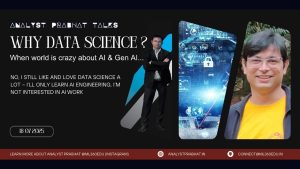
“No, I Still Like and Love Data Science a Lot – I’ll Only Learn AI Engineering, But I’ll Teach You Everything” – PK
In a world where Artificial Intelligence (AI) is becoming the centerpiece of modern innovation, many are swept away by the fascination with robotics, automation, and generative technologies. But for a few of us, those who’ve seen the beauty of logic, the art of data modeling, and the satisfaction in statistical clarity, Data Science remains our true passion. We may explore AI Engineering for the sake of expanding our toolkit, but our heart still belongs to Data Science. Let me explain why.
The Beauty of Data Science: Science First, Machine Later
At its core, Data Science is a deep, theoretical, and analytical discipline. It’s not just about building fancy tools or machines; it’s about understanding why things work. From statistical inference to probability theory, from hypothesis testing to machine learning optimization. Data Science trains the mind to ask questions, build predictive models, and interpret the world using data.
We learn to work with datasets, cleaning, analyzing, and modeling them. We dive into machine learning principles and mathematical calculations, often optimizing performance through techniques that are the backbone of AI today. Deep learning? That’s just another flavor we master, as we navigate neural networks and understand how layers, backpropagation, and gradient descent work in harmony.
Even Generative AI and large language models like GPT are deeply rooted in data science fundamentals. Without the foundational knowledge of data distribution, loss functions, or optimization, these models would never have been trained or tuned in the first place.
Why Then Learn AI Engineering?
While I’m not particularly drawn to “AI Work” in the conventional sense, working on robots, smart assistants, or industrial AI systems, I recognize the value in learning AI Engineering as a skill. It’s a way to understand how the systems we build as data scientists are used in the real world.
AI Engineering teaches the systematic design, deployment, and scaling of AI systems. From automating decision-making in factories to integrating AI modules in mobile apps, it focuses on practical implementation, not theoretical exploration. That’s where the line is drawn.
AI Engineering is machine-driven and focuses on structured execution over innovation. You learn to plug algorithms into production systems, automate processes with robotic precision, and refine performance based on engineering constraints. It’s critical in many domains, but for those who love working with abstract ideas, statistics, and model development, it lacks the thrill of discovery that Data Science offers.
The Theoretical vs. The Applied: Two Different Loves
There is a clear divide between AI Engineering and Data Science, and understanding this difference is vital.
-
- AI Engineering is less theoretical and more dependent on systems, architecture, and platforms. It’s about making things work efficiently at scale.
-
- Data Science is purely science-centric, focused on data behavior, patterns, algorithms, and modeling. It involves critical thinking, coding (mostly in Python, R, SQL), and drawing meaningful conclusions that influence decisions.
I admire AI Engineers, I just don’t aspire to be one. My curiosity lies in the numbers, in uncovering what they whisper about trends, human behavior, or business opportunities. I want to build smarter models, not just deploy them. I want to research new deep learning techniques, not just install existing ones.
The Future Belongs to Both, But I Know Where I Belong
We are at a turning point in technology, where revolutionary changes in algorithms, deep learning architectures, transformers like GPT, and generative synthesis will shape the next decade. Both Data Scientists and AI Engineers will be in high demand.
But while AI Engineering will bring efficiency, Data Science will continue to bring insight.
So yes, I’ll learn AI Engineering because it’s essential to know how systems run. But I’ll always love Data Science because it’s where systems begin. And that, for me, makes all the difference.
Conclusion: A Heart That Beats for Data
In a world dazzled by automation, I choose to remain a thinker, a Data Scientist first, always. Learning AI Engineering is like learning how to drive a powerful car. But Data Science? That’s understanding how the engine works, what makes it faster, and how it can evolve.
Let others race on the AI track. I’ll be in the lab, coding, modeling, optimizing, doing the real science behind it all.
Because I don’t just use data, I live it.
Author: Prabhat Kumar
#DataScience #DeepLearning #Statistics #AgenticAI