

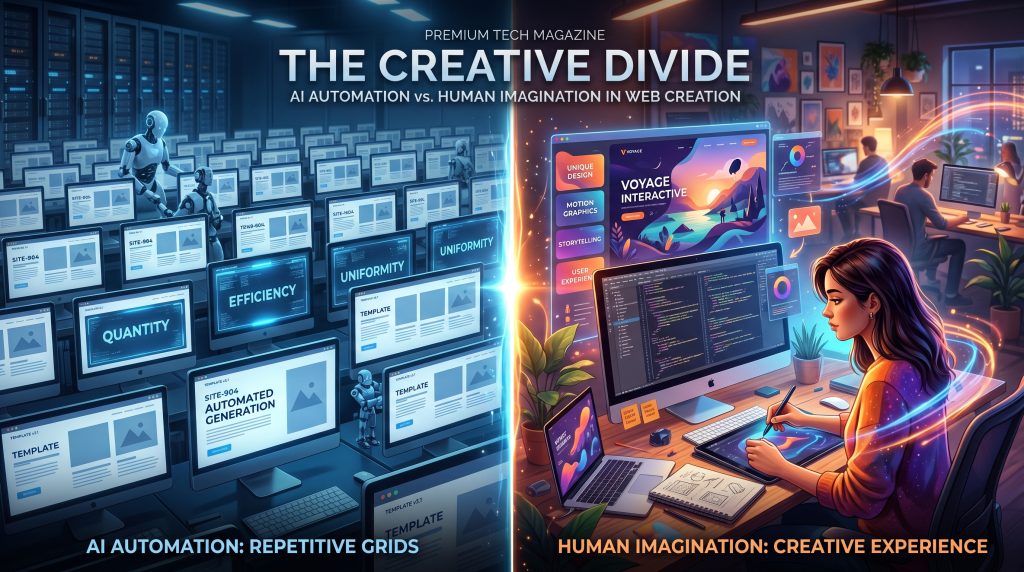
Let’s be honest: the internet is getting a bit crowded, and honestly, a little repetitive. We’ve all landed on websites that look exactly like five other sites we visited that same day. They use the same clean layouts, the same sterile fonts, and the same predictable structures.
But behind the scenes, a massive shift is happening. With the rapid rise of AI-assisted coding, modular bento layouts, and immersive 3D web features, the digital landscape is changing faster than ever.
It raises a fascinating question for anyone looking to break into the tech space or upgrade their skills: In a world where AI can generate a basic website in seconds, what should we actually be learning in Web Design and Web Development courses? If we want to stand out, the old cookie-cutter roadmaps just won’t cut it anymore. Let’s talk about what really matters when you’re looking to master the web today.
The Shift: Moving Beyond the Basics
A few years ago, a standard web course would teach you basic HTML/CSS layout templates, a bit of JavaScript, and maybe how to tweak a standard WordPress theme. Today, that’s just the baseline. The courses genuinely worth your time are shifting their focus from mechanical coding to deep user experience and advanced integration. Here is what modern web education looks like:
- Web Design is Becoming Art: Because anyone can prompt a basic UI, human design is swinging toward the unique—think organic shapes, kinetic typography that reacts to scrolling, and custom micro-animations that make a site feel alive and tactile.
- Web Development is About Ecosystems: Instead of just configuring separate tools, developers are learning to launch entire full-stack environments. It’s about end-to-end type safety, deploying apps directly to global edge networks for blazing-fast speed, and building seamless AI assistant interfaces directly into the user journey.
The real goal of a modern course isn’t just to teach you how to write code, but how to think like a digital architect.
My Experience: The Balance of Human Craft and Automation
Having spent plenty of time navigating the ins and outs of web systems and digital strategy, I’ve learned a crucial lesson: automation is a tool, not a replacement for good taste.
An AI can write a clean block of code, but it doesn’t understand human emotion. It doesn’t know how to create an inclusive, highly accessible layout that guides a user’s eyes seamlessly down a page. It doesn’t know how to make a brand feel authentic, warm, or beautifully imperfect.
The best courses don’t shy away from modern automation they teach you how to use it to handle the tedious stuff so you can spend your energy on creative constraints, performance optimization, and elite user experiences.
Over to You: What’s Your Verdict?
Whether you are looking to build a career, launch a personal project, or create a course of your own, the future of the web belongs to those who bridge the gap between technical logic and human creativity.
So, I want to open up the floor to you:
What is the biggest pet peeve you have when navigating modern websites
today?
Let’s get a real discussion going in the comments below. Share your thoughts, your experiences, or your skepticism let’s talk about it!
If you were signing up for a web course today, would you lean more toward the visual side (Web Design) or the logic and framework side (Web Development)?
Do you think AI tools will make learning traditional coding obsolete, or will they make deep development skills even more valuable?
Proin ac quam et lectus vestibulum blandit. Nunc maximus nibh at placerat tincidunt. Nam sem lacus, ornare non ante sed, ultricies
Proin ac quam et lectus vestibulum blandit. Nunc maximus nibh at placerat tincidunt. Nam sem lacus